Partridge Berry
Mitchella repens
Description
overall appearance
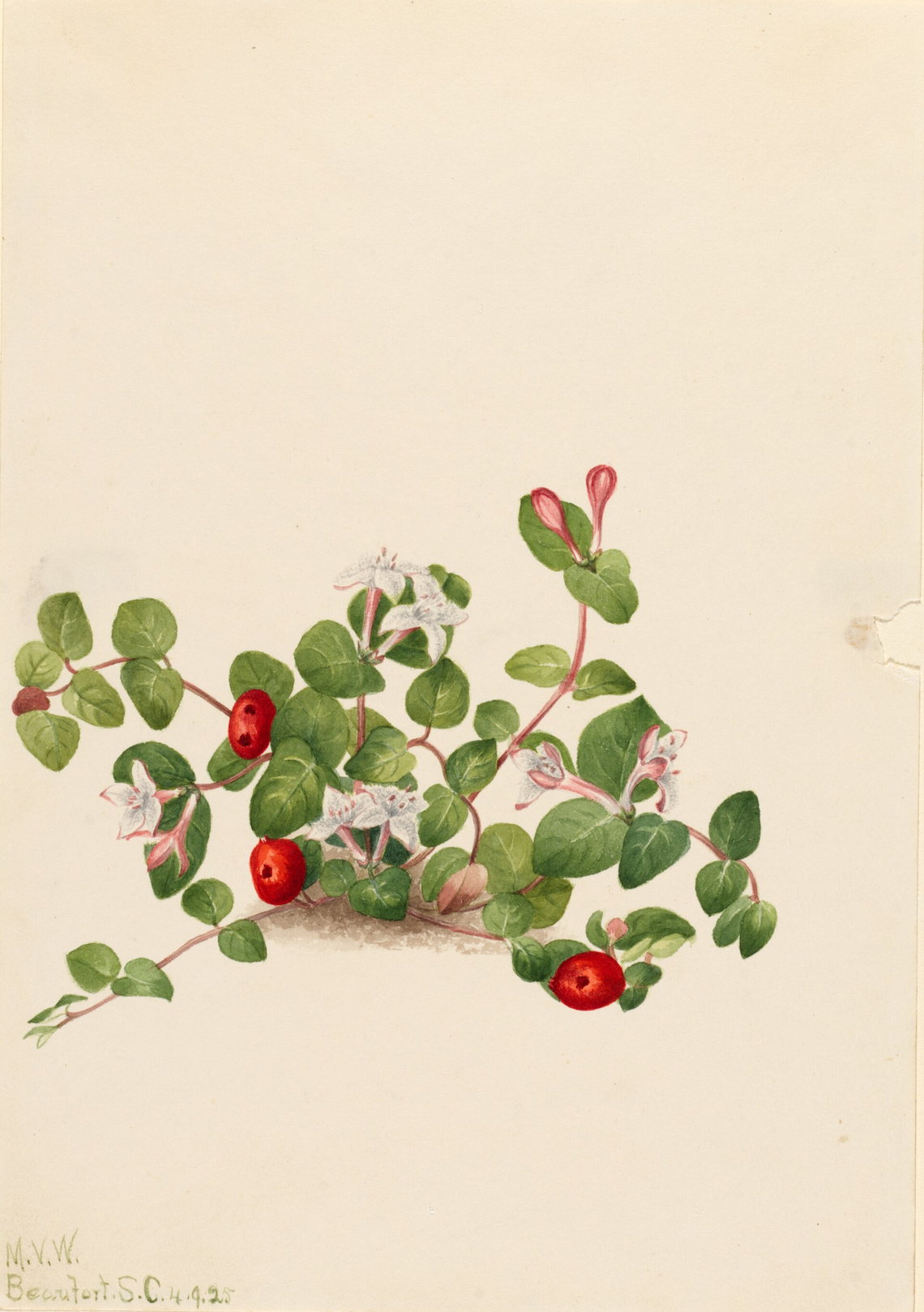
Partridge berry is a low-growing, evergreen perennial vine that forms dense mats along the forest floor. The trailing stems can extend 6-12 inches long.
roots
Fibrous root system with adventitious roots developing at nodes along the creeping stems, allowing the plant to spread vegetatively.
stem
Slender, trailing stems are smooth, reddish-brown, and woody at the base. Stems root at nodes where they touch the ground.
leaves
Small, opposite, rounded to oval leaves are 1/4 to 1/2 inch long. Leaves are dark green, glossy, evergreen with prominent white veining and smooth margins.
flowers
Small, tubular, white to pinkish flowers appear in pairs at stem tips in late spring to early summer. Each flower has 4 petals and a sweet fragrance.
fruits/seeds
Bright red berries, about 1/4 inch diameter, persist through winter. Each berry is actually formed from two fused flowers, hence "two-eyed berry."
Active Compounds
Traditional Uses
- Pregnancy tonic and labor preparation
- Menstrual irregularities and painful periods
- Urinary tract infections
- Diarrhea and digestive issues
- Sore nipples during nursing
- Eye irritations and conjunctivitis
Modern Applications
- Uterine tonic during pregnancy
- Astringent for topical applications
- Mild diuretic action
- Anti-inflammatory for mucous membranes
- Traditional women's health support
⚠️ Safety Information
Contraindications
- Early pregnancy (first and second trimester)
- Active bleeding disorders
- Severe kidney disease
Side Effects
- Generally well-tolerated
- Possible gastric upset with large doses
- Rare allergic reactions
Drug Interactions
- May enhance effects of blood-thinning medications
- Potential interactions with diuretic medications
- Caution with other uterine stimulants
Parts Used
- Leaves and stems (aerial parts)
- Occasionally the whole plant
Preparation Methods
1-2 tsp dried herb per cup water, steep 10-15 minutes
Simmer gently for 10 minutes for stronger preparation
1:5 ratio in 25% alcohol, 1-2 ml three times daily
Fresh crushed leaves for external application
Weak tea preparation, cooled and strained
Related Plants
Cat's Claw
Uncaria tomentosa
Cleavers
Galium aparine
Noni
Morinda citrifolia
Raspberry Leaf
Rubus idaeus
Slippery Elm
Ulmus rubra
Mangosteen
Garcinia mangostana