Description
overall appearance
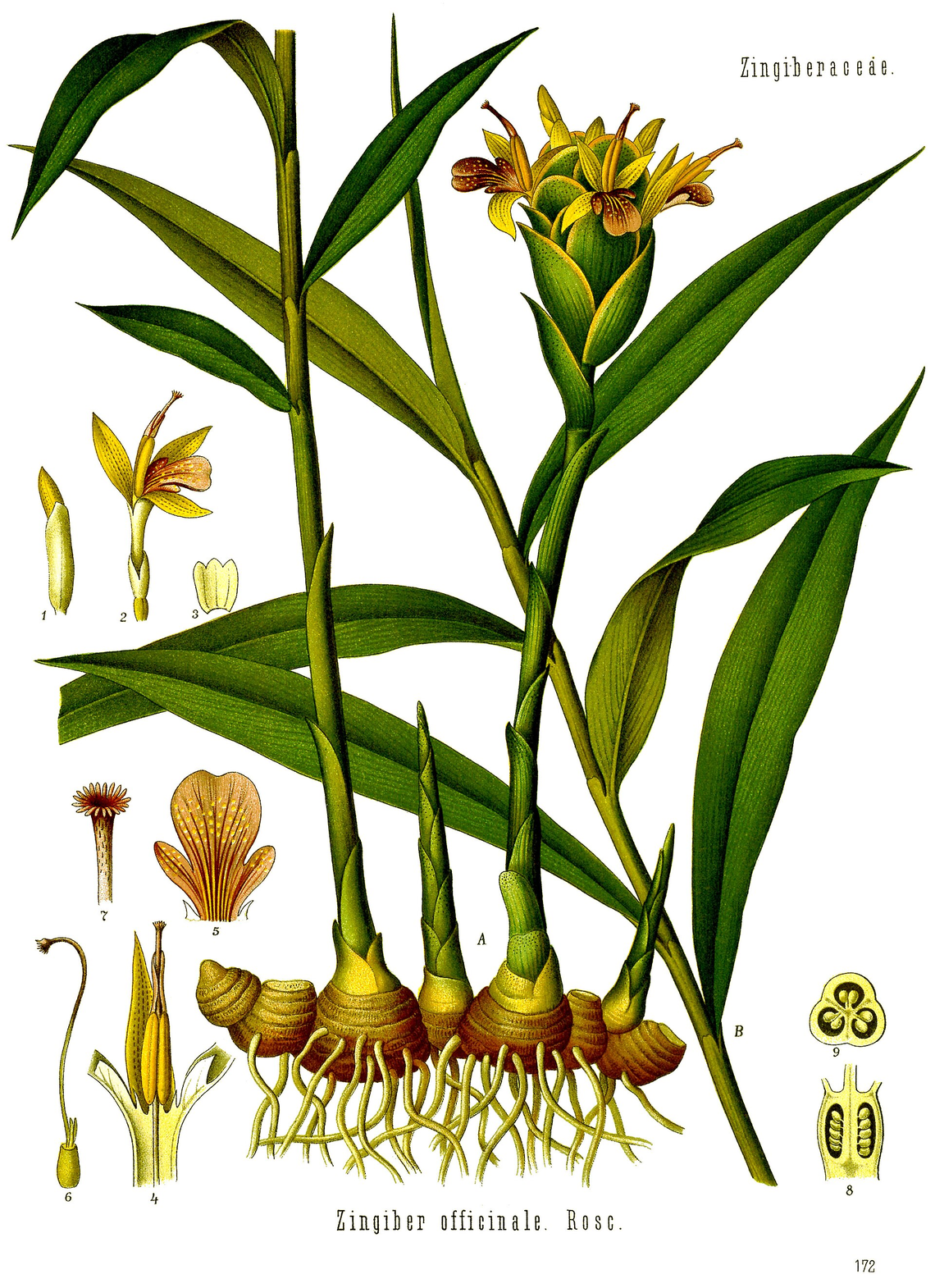
Perennial herbaceous plant growing 2-4 feet tall with reed-like stems, narrow leaves, and thick, knobby underground rhizomes.
roots
Thick, irregularly branched rhizome system with finger-like projections; externally light brown with thin skin, internally pale yellow to white, intensely aromatic and pungent.
stem
Erect leafy shoots (pseudostems) formed by overlapping leaf sheaths, growing 2-4 feet tall, smooth and green.
leaves
Alternate, linear-lanceolate leaves 6-12 inches long and 0.75-1 inch wide, with entire margins, prominent parallel veins, and smooth surfaces.
flowers
Rarely flowers in cultivation; when present, flowers are yellow-green with purple streaks, arranged in dense cone-like spikes 2-3 inches long.
fruits/seeds
Rarely produces fruit in cultivation; propagated through rhizome division.
Active Compounds
Traditional Uses
- Traditional Chinese Medicine for digestive disorders, nausea, cold conditions
- Ayurvedic medicine for digestive fire (agni), respiratory conditions
- Motion sickness and morning sickness relief
- Circulation improvement and warming remedy
- Anti-inflammatory for arthritis and muscle pain
- Respiratory infections and coughs
Modern Applications
- Nausea and vomiting prevention (pregnancy, chemotherapy, motion sickness)
- Anti-inflammatory effects for arthritis and muscle pain
- Digestive health and gastroprotection
- Circulation enhancement and cardiovascular support
- Antimicrobial and antiviral properties
- Pain relief and fever reduction
⚠️ Safety Information
Contraindications
- Gallstones (may increase bile production)
- Bleeding disorders or before surgery
- Severe heart conditions (high doses)
Side Effects
- Heartburn or stomach upset with large doses
- Increased bleeding risk
- Potential blood pressure changes
- Skin irritation with topical use
Drug Interactions
- Blood-thinning medications (may enhance effects)
- Diabetes medications (may lower blood sugar)
- High blood pressure medications
- Gallstone medications
Parts Used
- Fresh rhizomes (most common)
- Dried rhizomes
- Essential oil extracted from rhizomes
Preparation Methods
1-2 teaspoons fresh grated ginger per cup hot water, steep 5-10 minutes
Fresh or dried ginger simmered 10-15 minutes
1:5 ratio in 60% alcohol, 1-3 ml three times daily
Fresh grated ginger applied to affected areas
Fresh ginger in carrier oil for massage
Related Plants
Cardamom
Elettaria cardamomum
Turmeric
Curcuma longa
Gotu Kola
Centella asiatica
Andrographis
Andrographis paniculata
Astragalus
Astragalus membranaceus
Bhringaraj
Eclipta prostrata